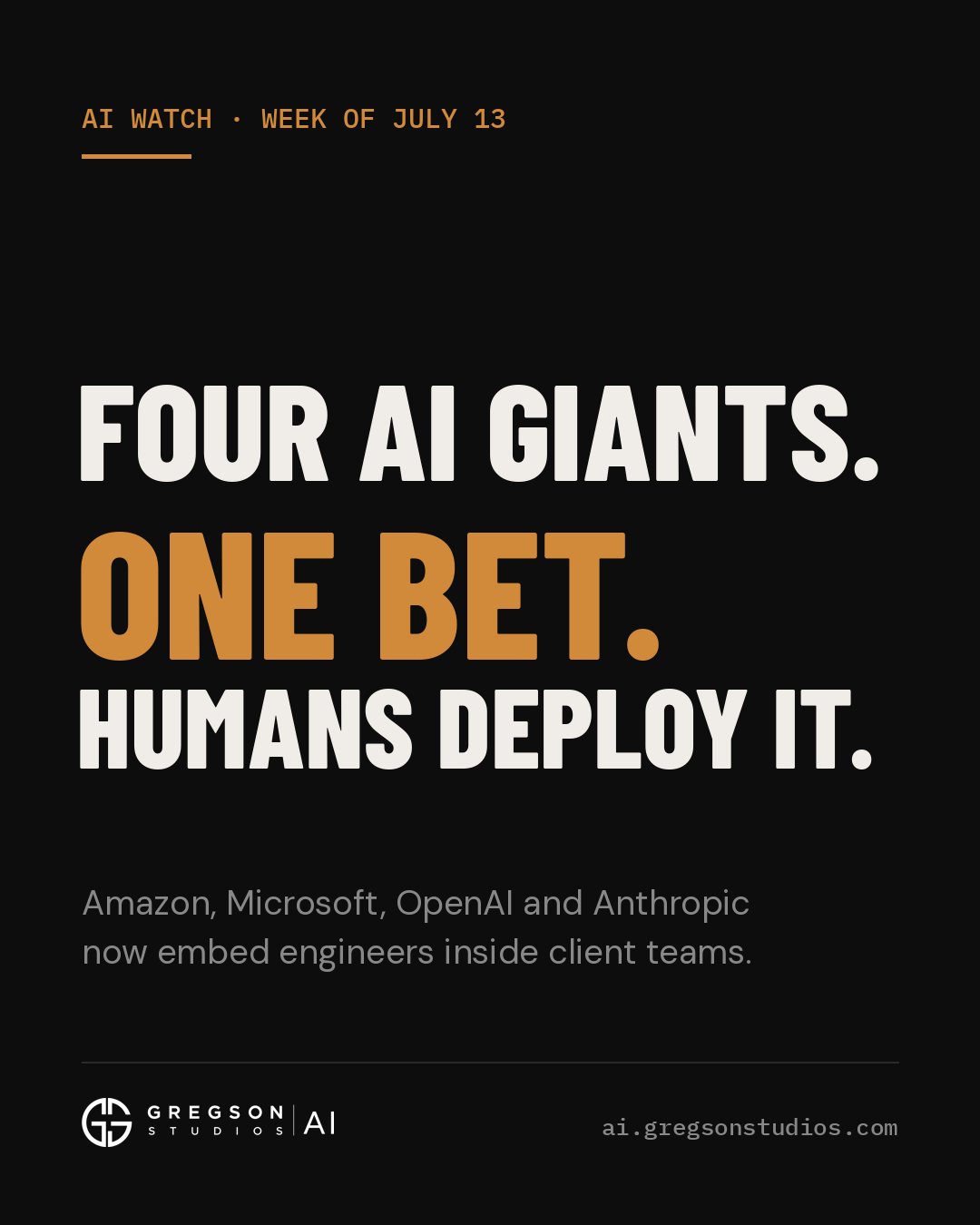
When the largest AI companies in the world start paying billions of dollars to send engineers inside their customers’ businesses, something fundamental has shifted. This week, that pattern became impossible to ignore.
Amazon announced a new $1B organization dedicated to embedding forward-deployed engineers inside client companies to deploy purpose-built AI agents and make those customers self-sufficient. Microsoft preceded them months earlier with a $2.5B Frontier unit built on the same model. OpenAI and Anthropic followed. California sealed a Claude deal that included training and support as a core component, not an add-on. Meanwhile, Meta formed an “Enterprise Solutions” unit to embed engineers inside corporate clients, and OpenAI released a new workspace product with billing that scales by task complexity.
The message from every front is the same: AI adoption requires humans on the ground helping with deployment, and training your team to run it yourself beats paying consultants to come back forever.
This changes what a small business owner should do next. It also changes the risk profile of waiting.
OpenAI releases GPT-5.6 in three tiers and launches ChatGPT Work

What happened: On July 9, OpenAI released GPT-5.6 in three tiers (Sol, the most capable; Terra, balanced and roughly half Sol’s cost; Luna, fastest and cheapest), available across ChatGPT, the API, and Codex. They also launched ChatGPT Work, a workspace product with 15+ third-party integrations callable by @ mention and usage-based billing that scales by task complexity.
Why you should care: Every AI model is not the right choice for every task. A tiered menu lets you match model cost to job value. Luna handles most small business work at a fraction of Terra’s cost, and Terra handles most everyday tasks that once required the largest models. Overspending on capability you don’t use is waste. Underspending and having a job that stalls is also waste. The tiered approach solves the middle ground.
What to do about it: Run a test on one workflow you do repeatedly. Start with the cheapest option (Luna). If it stalls, try Terra. Move to Sol only if the job requires frontier reasoning or long agentic chains. Log the cost and time saved. That number becomes your business case for other workflows.
Source: MarketingProfs AI Update, July 10, 2026
—
Anthropic launches Claude Cowork for mobile and web

What happened: Anthropic released Claude Cowork on mobile and web, a product designed to delegate multi-step knowledge work across documents, spreadsheets, and presentations. Instead of asking a single question and getting a single answer, Cowork hands off a task and returns finished work.
Why you should care: The value of AI shifts from novelty (quick factual lookups) to real time savings. Time savings come from task handoff, not query answering. A question takes 30 seconds to write and 10 seconds to answer, but saves you 5 minutes of thinking. A task like “read these three contracts, mark the payment terms, and send me a summary” saves you 90 minutes and takes 2 minutes to hand off.
What to do about it: Pick one workflow that repeats at least weekly. Something you currently do by hand that takes at least an hour. Test it on Cowork. Time the before and after. If the result saves real time and is accurate enough to use, build it into your process and free up hours per week.
Source: MarketingProfs AI Update, July 10, 2026
—
Amazon commits $1B to forward-deployed AI engineers

What happened: Amazon announced the formation of a new $1B internal organization of forward-deployed engineers. Their job is to embed inside client companies, deploy purpose-built AI agents, and make the customer self-sufficient to run them. This follows Microsoft’s $2.5B Frontier unit, OpenAI’s deployment teams, and Anthropic’s enterprise organization.
Why you should care: Every single largest AI company now operates the same bet: AI adoption needs humans on the ground. Software alone does not work. Access alone does not work. Deployment help and training are not nice extras; they are the core of the business. When a company puts a billion dollars behind a strategy, you are watching their highest conviction bet. All four companies made this bet.
What to do about it: Do not wait for a vendor to send someone to you. You can get this help now. Find a consultant or partner who understands both your business and the specific AI tools you want to deploy. Get them to help you stand up one workflow. Insist that training is part of the deal, not something you pay extra for later. Make sure the goal is your team running it without ongoing help.
Sources: TechCrunch, June 30, 2026; AWS Weekly Roundup, July 6, 2026
—
Meta launches enterprise AI business agent and forms an embed unit

What happened: At its WhatsApp Conversations conference, Meta announced an enterprise-focused AI business agent that can book appointments and close sales on WhatsApp and Messenger, where 1M+ businesses already run chatbots. Meta also formed an “Enterprise Solutions” unit to embed engineers and product managers inside corporate clients.
Why you should care: An AI agent that lives on channels where your customers already message you is dramatically easier to deploy than software that requires them to adopt a new tool. If your customers message you on WhatsApp or Messenger to ask about your service or book time, an agent that can handle those conversations (and escalate to you if needed) cuts manual work and improves response time.
What to do about it: If more than 20 percent of your inbound inquiries come through WhatsApp or Messenger, this is worth a test. Work with someone who can set it up, test the agent’s accuracy, and make sure it escalates edge cases to you. Measure: message volume before and after, and which conversations the agent handled end to end versus which ones you had to take over.
Sources: AI Business, July 2026; Yahoo Finance, 2026
—
California signs a discounted-Claude deal with training bundled in

What happened: California negotiated an agreement with Anthropic for discounted Claude access across state agencies and local governments, with training and support included. The state is using Claude to help employees draft documents and analyze information.
Why you should care: Large, cautious public institutions move slowly. They do not adopt something new without proof it works. When California (one of the world’s largest governments) pairs AI access with training as a standard part of the deal, that is a signal that AI is no longer an experiment. It is moving to standard operating tool status. It also signals that training is not an afterthought. It is part of how adoption actually works.
What to do about it: When you negotiate an AI vendor deal or hire someone to help you deploy AI, training is a line item, not an option. Do not accept a deal that treats training as a premium add-on you pay extra for later. Build it into the agreement from the start.
Sources: Crescendo AI, week of July 6, 2026; MarketingProfs AI Update, July 10, 2026
—
Anthropic files confidentially for an IPO

What happened: Anthropic submitted a confidential draft IPO registration tied to a reported valuation around $965B, with public filing expected later this summer and pricing targeted for fall. The company’s annualized revenue run rate reportedly crossed $47B, and it has told investors it expects to reach its first profitable quarter soon.
Why you should care: When a company goes public, scrutiny increases. More transparency, more reporting, more disclosure. That is generally good for trust. It also signals that the AI market is maturing beyond private speculation and moving to publicly-traded infrastructure. Claude is not a bet anymore. It is becoming infrastructure. However, infrastructure can change, move, or shut down. Vendor risk is real.
What to do about it: Build your AI workflows in a way that could run on another capable model if the market shifts. Avoid deep integration with APIs or features you could not easily replicate with a different vendor. Your business should not depend on one company’s continued success. Diversify on the underlying tools, even if Claude is your preferred first choice.
Sources: FAQ.com.tw, July 7, 2026; TechCrunch, June 1, 2026
—
Anthropic publishes research on Claude’s internal workspace

What happened: Anthropic published interpretability research describing the J-space, a small neural workspace inside Claude that holds concepts the model is actively working with before they appear in the output. The work gives researchers better visibility into what the model is thinking while reasoning.
Why you should care: Trust in AI tools scales with visibility. If you can inspect and understand how a model reasons about your business problem, you are more confident deploying it on real work. Transparency is not just nice for academic reasons. It is a business requirement when AI moves from a toy to a production tool. The more auditable the model, the more responsibly you can use it.
What to do about it: When evaluating an AI tool for a business-critical task, ask about its interpretability and auditing capabilities. How can you inspect what the model is thinking? What happens if it makes a mistake? Can you see why? That visibility should factor into your choice of vendor and model.
Source: MarketingProfs AI Update, July 10, 2026
—
The Gregson Studios AI perspective
I built Gregson Studios AI on a simple bet: AI adoption works when it is bundled with deployment help and training. Your team needs to learn to run it themselves, not outsource it to consultants forever. That is not my opinion anymore. It is now the unanimous conviction of Amazon, Microsoft, OpenAI, and Anthropic, each backed by a billion or more in internal resources.
This week also made clear that capabilities are becoming cheaper, smaller models are becoming more capable, and the tools are becoming more transparent. That is the opposite of a reason to wait. Access without training stalls. Capabilities without deployment help stall. Training without accountability for your team running it yourself is just staff augmentation, not a lasting change.
The pattern playing out this week is this: pick one workflow that repeats and wastes your time. Find someone who knows both your business and the AI tools. Have them deploy the workflow end to end. Train your team to run it. Measure the time and money you save. Move to the next workflow. Repeat.
That is Gregson Studios AI. This week, the four largest AI companies confirmed it is the only model that actually works at scale.
—
A practical next step
You have one repeatable workflow in mind right now. Something you do by hand at least weekly that takes more time than it should. That is your start point. Start with a conversation about that workflow, no pressure, no pricing talk yet. We help you see if AI could help, how much time you might save, and what the deployment would look like.
Go to https://ai.gregsonstudios.com and pick a time that works for you.
—
FAQ
Q: Do I need to buy expensive enterprise software to get this working?
A: No. The most effective starting point is usually the lowest-cost option (Luna, Claude’s base tier, or even free trial access to test a workflow). You test on cheap tools first, measure the results, and only upgrade the model or software if the cheap option stalls. That is what we guide you through.
Q: How long does deployment take?
A: Depends on the workflow. A single repeatable task (processing emails, summarizing documents, routing customer inquiries) usually takes 2 to 4 sessions to stand up, test, and hand off to your team to run. A more complex multi-step process takes longer. We figure out your specific timeline during the initial conversation.
Q: What if the AI makes mistakes on my workflow?
A: That is a real question and a real design step. Part of the deployment process is finding the edge cases where the model fails, building safeguards (like requiring human review before certain actions, or flagging low-confidence outputs), and testing the workflow until it reaches a reliability level your business can accept. Not all workflows should be fully automated. Some need human judgment at critical points. That is built in from the start.
—
Sources
OpenAI GPT-5.6 and ChatGPT Work announcement, MarketingProfs AI Update, July 10, 2026
Anthropic Claude Cowork launch, MarketingProfs AI Update, July 10, 2026
Amazon $1B forward-deployed engineers, TechCrunch, June 30, 2026
AWS Weekly Roundup, July 6, 2026
Meta enterprise AI business agent and embed unit, AI Business, July 2026
Meta enterprise AI business agent, Yahoo Finance, 2026
California Claude deal with training, Crescendo AI, week of July 6, 2026
California Claude deal, MarketingProfs AI Update, July 10, 2026
Anthropic IPO filing, FAQ.com.tw, July 7, 2026
Anthropic IPO filing, TechCrunch, June 1, 2026
Anthropic interpretability research J-space, MarketingProfs AI Update, July 10, 2026